
Exploring the remote, rarely visited, areas of the Great Barrier Reef
Australia’s Great Barrier Reef is the world’s largest coral reef system that stretches over 2,300 Km along the east coast of Queensland. Composed of over 2,900 individual reefs and 900 islands this amazing natural structure is listed as a World Heritage site and is one of the greatest places to scuba dive and snorkel on the planet.
There are many popular tourist destinations along the East Coast of Australia that allow divers and snorkelers access to the Great Barrier Reef every day, with Cairns being known internationally as the gateway to the Great Barrier Reef. To access any of the Far North sections of the Reef, the large coastal town of Cairns has to be the starting place and this is where the winner of Dive Log’s Best Australian Liveaboard 2012, MV Spirit of Freedom, calls home.
Not that Spirit of Freedom is ever at home much as she spends all her time at sea, traversing the reef systems from Cairns to Ribbon Reef 9 and 10 from Monday to Wednesday on the 3 Day Cod Hole Trip; then heads out to the deep oceanic Osprey Reef on the 4 Day Coral Sea Trip before returning to Cairns on Monday morning. During 2012, I had the privilege to be the Trip Director of Spirit of Freedom and co-ordinated two of Spirit of Freedom’s three Far North Exploration Trips, the first at the end of January 2012 and the second in November 2012 that incorporated the Total Solar Eclipse.
Each trip offered divers the opportunity to dive the continuous stretch of reef that extends to the tip of Australia where the tropical water is warm, clear and full of marine life. The people that undertake one of these trips are a diverse mix; some looking to embrace a new area of diving; some armed with dual strobes and huge cameras, some wielding top of line video cameras, some just there for the thrill of it, but all of them armed with a sense of adventure that creates a camaraderie amongst people who share the same passion; scuba diving. The atmosphere on the boat was always tinged with excitement in the knowledge that we would be diving where very few people have ever dived before.
The first and last few days of trips are spent in the well-known areas that Spirit of Freedom regularly visits, diving iconic sites such as Steve’s Bommie, Pixie Pinnacle and the Cod Hole in the Ribbon Reefs where divers immerse themselves in the clouds of brightly coloured tropical reef fish, hunt for nudibranchs, pipefish, Wobbygong Sharks and are amazed by the size of the friendly diver sized Potato Cod. Moving out into the Coral Sea to dive the world famous North Horn, with its population of Grey Reef Sharks and the opportunity to experience the Shark Feed, drift along the 1,00m deep walls of Around The Bend and explore the incredible topography of Admiralty gives divers a sense of what is to come. Once Spirit of Freedom travels north from Lizard Island, the reality of being in the remote Far North regions of the GBR becomes evident; gone are the laminated dive site maps, mooring lines and accurate tide times, replaced by roughly sketched mud maps, live drops, drift dives and tender pickups.
Within two days travel of Lizard Island are Sand Banks 1 to 8 and Tijou Reef. The Sand Bank area is littered with reefs in between the picturesque sandy beaches of the coral cays. Turtle tracks cut their way through the sand to the high tide mark where the piles of discarded sand give the impression hastily built sand castles on the beach. Flocks of migratory seabirds, such as Booby, Tern and Shearwaters, crowd together on the sparse vegetation that covers the highest parts of the islands and launch themselves into the air at the slightest noise, filling the sky with the sounds of a million wings beating furiously as they try to gain altitude. The tide streams through the narrow channels between the cays giving ample opportunity to drift along the walls, surrounded by shimmering silver schools of Fusiliers, Barracuda and Trevally while looking into the blue for Eagle Rays and Reef Sharks. The southern reefs of this area teem with fish life and feature immense coral formations growing together to form a maze of tunnels, canyons and swim throughs with one idyllic spot being discovered at Aladdin’s Cave where the sunlight streaming through a gap in the reef illuminates a massive red fan to create an ethereal scene that simply cannot be described with words, photographs or even video; it’s just a place that you have to go and experience for yourself.
Tijou Reef has many hidden secrets; towering coral spires covered with macro life, stunning branching coral fields, stretching as far as the eye can see, and incredible topography. One incredible site is in the inaccessible central lagoon that requires divers to be dropped off by tender. This can only be achieved at high tide and requires a 10-minute tender ride over the top of the reef. As the divers descend next to the interior wall of the lagoon, the reef wall suddenly disappears, arching back underneath itself, creating a massive overhang that gives the divers an intricate tunnel system to explore between 10m and 20m. Exiting from the tunnel system and encountering a pair of 4m Manta Rays spiralling on the their wing tips results in the return tender ride being full of exited chatter and gloating waving of the arms alerts everyone on Spirit of Freedom as the tender pulls alongside.
Mantis and Wishbone Reef’s plunging outer walls start with a gentle slope of branching corals before the smaller and sturdier plate corals take over. Off the spectacular wall of Mantis Reef with its intricate ridges and undulations, a Scalloped Hammerhead was spotted that almost rivalled spending over 45 minutes swimming alongside the largest fish in the ocean, a Whaleshark, in the lagoon of Wishbone Reef. The graceful motion of the giant white spotted fish captures the undivided attention of anyone in its presence and it is a very humbling experience to watch a 7m long fish swim directly over the top of you. Leaving Wishbone Reef Spirit of Freedom has travelled nearly 400 nautical miles from Cairns, following the edge of the continental shelf, and is almost halfway to Ashmore Reef, the deep oceanic reef that lies east of Cape York. North of Wishbone Reef there is an expanse of unsurveyed area on the charts before reaching the Great Detached Reef (GDR). With over 12 years combined experience driving Spirit of Freedom, Captains Tony and Cameron prudently avoid this area but are very interested in Wood Reef, right on the northern tip of the unsurveyed area between Wishbone and the GDR. The crew find an old chain hanging out of a gap in the coral as they evaluate one of the many points or promontories of coral sticking out of the main section of Wood Reef. While discovering that this part of Wood Reef had been dived before, it is easy to see why. The point drops off into the depths several hundred metres below, Silvertip sharks circle off the point and a massive tunnel, shrouded with huge fans and soft corals, entices the divers to cut straight through the reef structure and appear right at the back of the boat. The plummeting walls of Wood Reef drop over 200m and as everyone descends in a gentle current a magnificent 3m Pacific Sailfish spreads it huge dorsal fin and turns sharply to one side before disappearing from sight with a single flick of it tail.
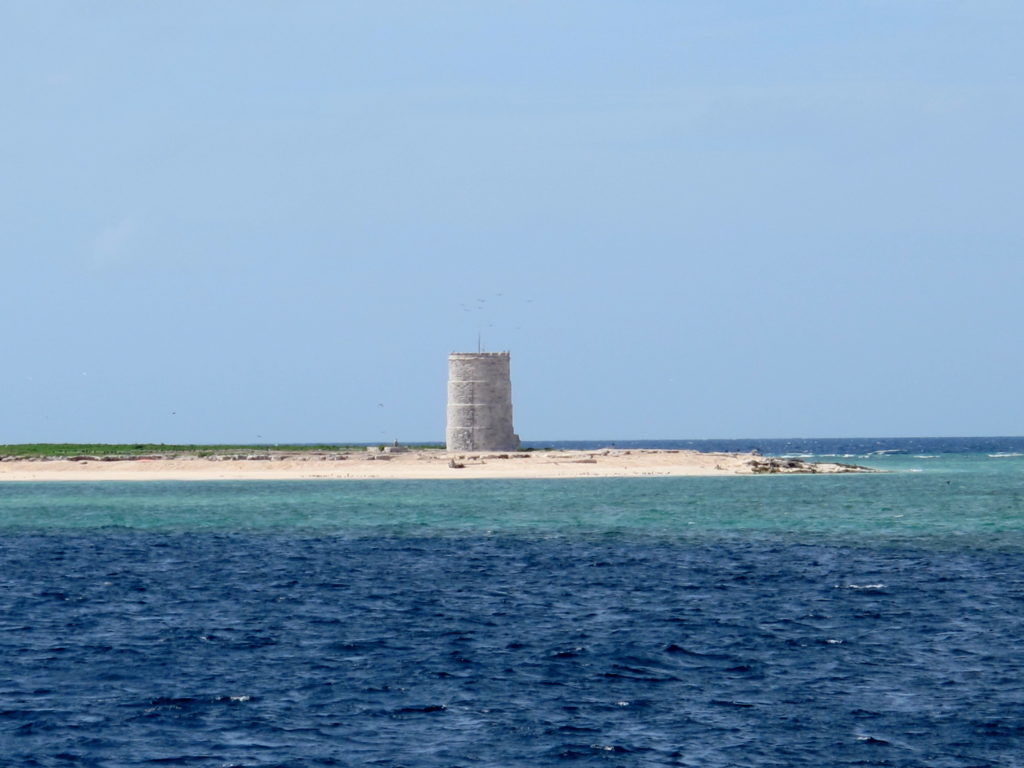
The Great Detached Reef sits just off the edge of the continental shelf and rises to the surface from the ocean floor 1,400m below. The sharks here are far more inquisitive than their southern relatives, primarily due to the lack of familiarity with divers, and the first divers in the water would return with stories of being ‘buzzed’ by curious Silvertips, Grey and Blacktip Reef Sharks. Just 3 miles north of the GDR is Raine Island, the site of the oldest European structure in tropical Australia, a stone beacon built in 1844, and harbours the world’s largest remaining population of Green Turtles. In order to protect the turtles’ natural habitat, the island is totally protected from public access and has a no-entry zone that extends into the ocean. There is only a small section of the reef structure of the island that can be dived but the clarity of the water, the plethora of Green Turtles, Silvertip, Black Tip and Grey Reef sharks, combined with the possibility of seeing a Tiger Shark, known to feed on the exhausted female Green Turtles, are worth timing the visit to have the right conditions.
Travelling north from the GDR the next stop is the deep oceanic Ashmore Reef. The lagoon area is over 70km long, 30km wide and its average depth is 50m. There are towering pinnacles of coral that rise from 50m right up to the surface dotted all over the inside edges of the lagoon but one of the highlights is the massive spire, right in the centre of the lagoon, which is covered in an astonishing variety of hard corals, each one growing over the top of its neighbour in the eternal battle for underwater real estate. Along the more protected inner edges of the lagoon, the inner walls are decorated in the same phenomenal variety of coral, while schools of tropical reef fish cascade along the 40m deep slopes. Here you will find schools of fish that are only ever seen in singles or pairs on the reefs further south.
Spirit of Freedom ventures even further north towards the equator, crossing the 9th parallel, having started in Cairns at the 17th parallel many days before. With perfect glass out conditions everyone is on lookout for the edge of Boot Reef, straining their eyes to see any waves breaking over the edge of the oceanic Coral Sea reef, which rises from the depth of 800m to just break the surface. Boot Reef’s walls are sheer vertical drops with massive crevasses cutting into the top 10m of reef, creating a maze of swim throughs and tunnels to be explored. Just south of Boot Reef are two deep-sea pinnacles that are barely 500m in diameter. These pinnacles have deep crevasse’s cut into the plummeting walls and feature the most amazing plate and table coral growth on their sheltered sides that combine with an incredible amount of pelagic fish schooling, numerous shark encounters and stunning drop offs to give the sense of diving somewhere extremely remote and rarely visited.
After 7 days of travelling northbound, it is time to finally turn and head south. As Spirit of Freedom leaves the most remote of the Far North reefs there is a sense of accomplishment having travelled over 600 nautical miles from Cairns and discovered locations and marine life that can only be described as treasures of the natural world. The one redeeming factor about the return journey is that there are just as many amazing places to discover and dive on the return journey south!